Super Mona in jolt
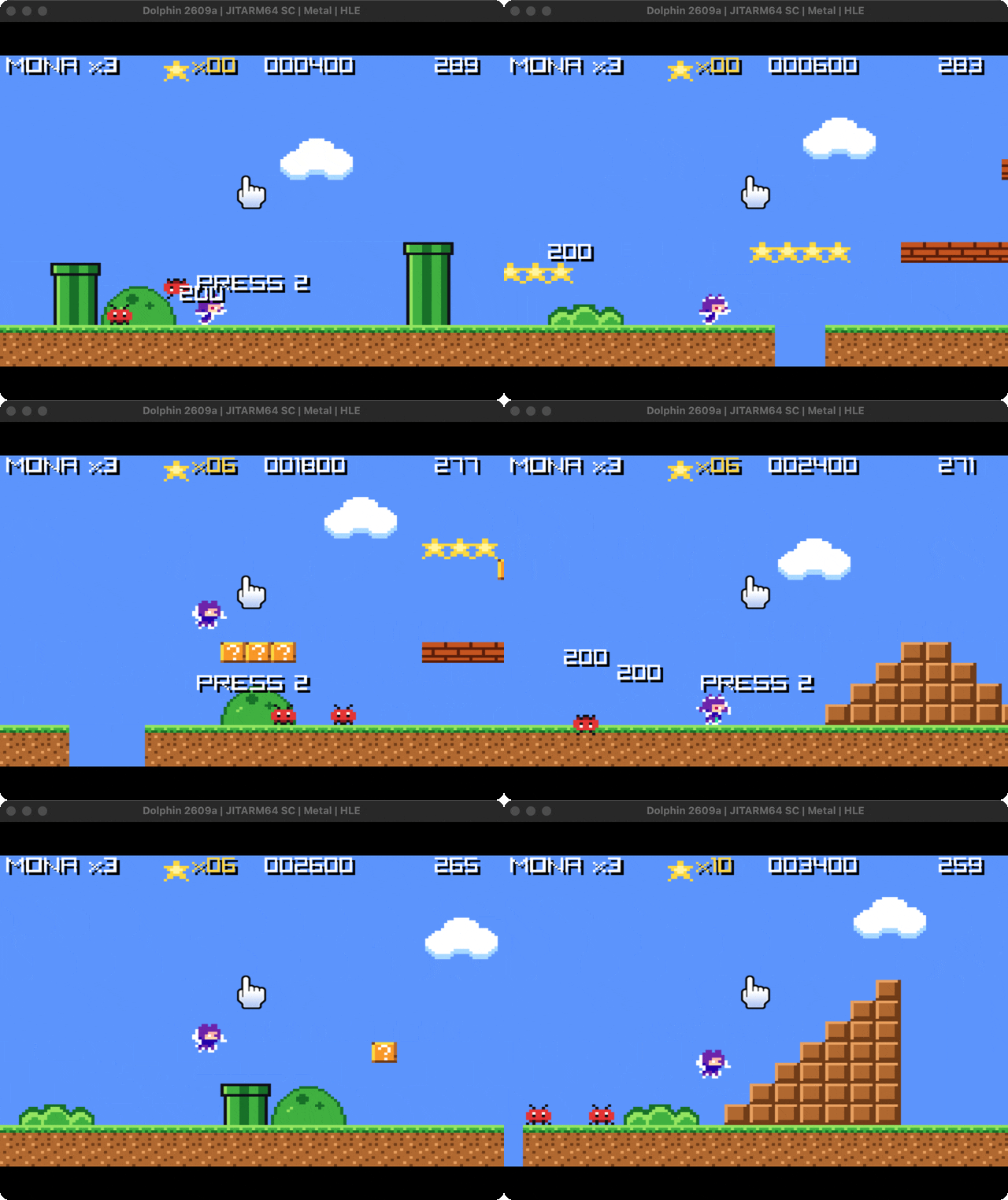
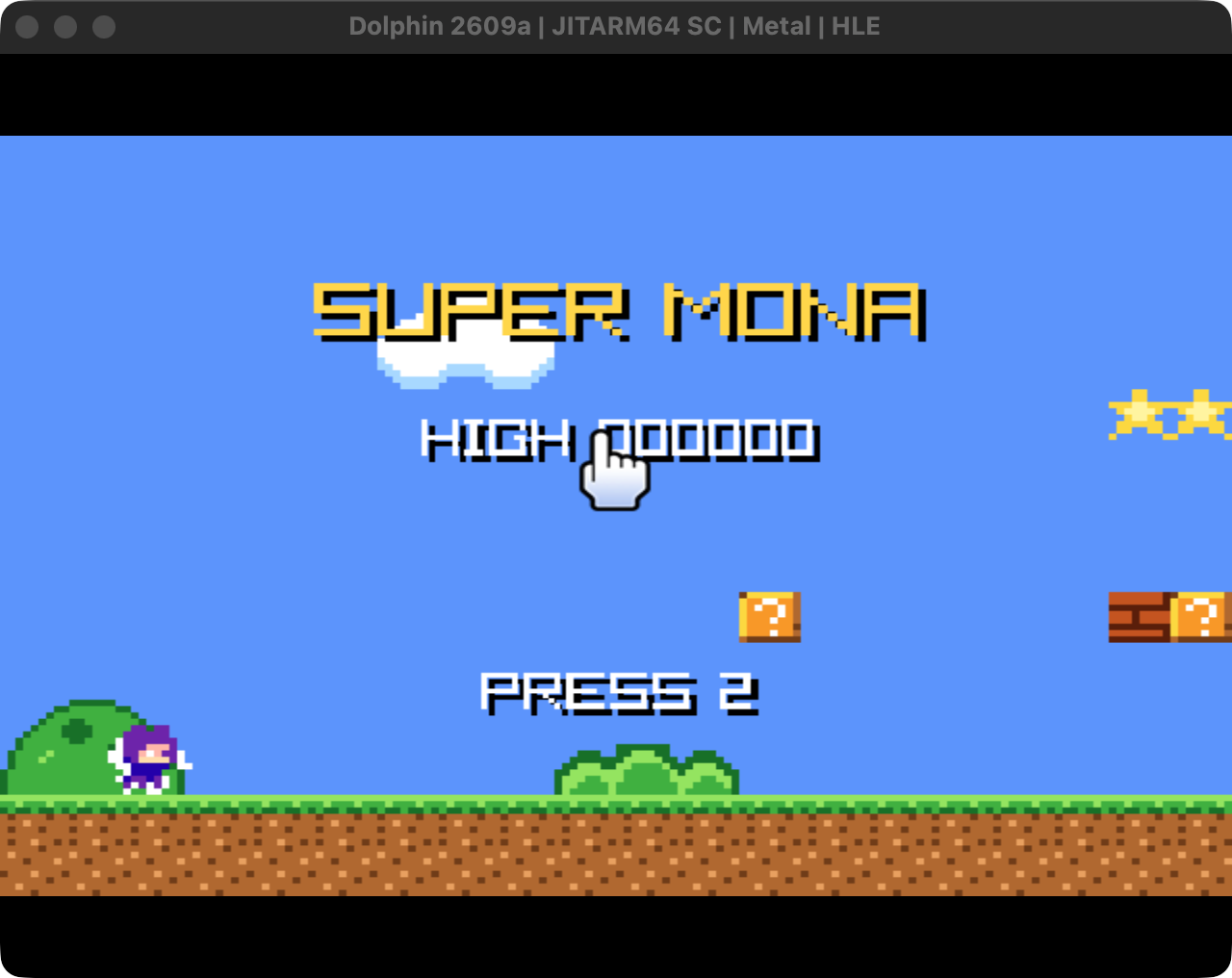
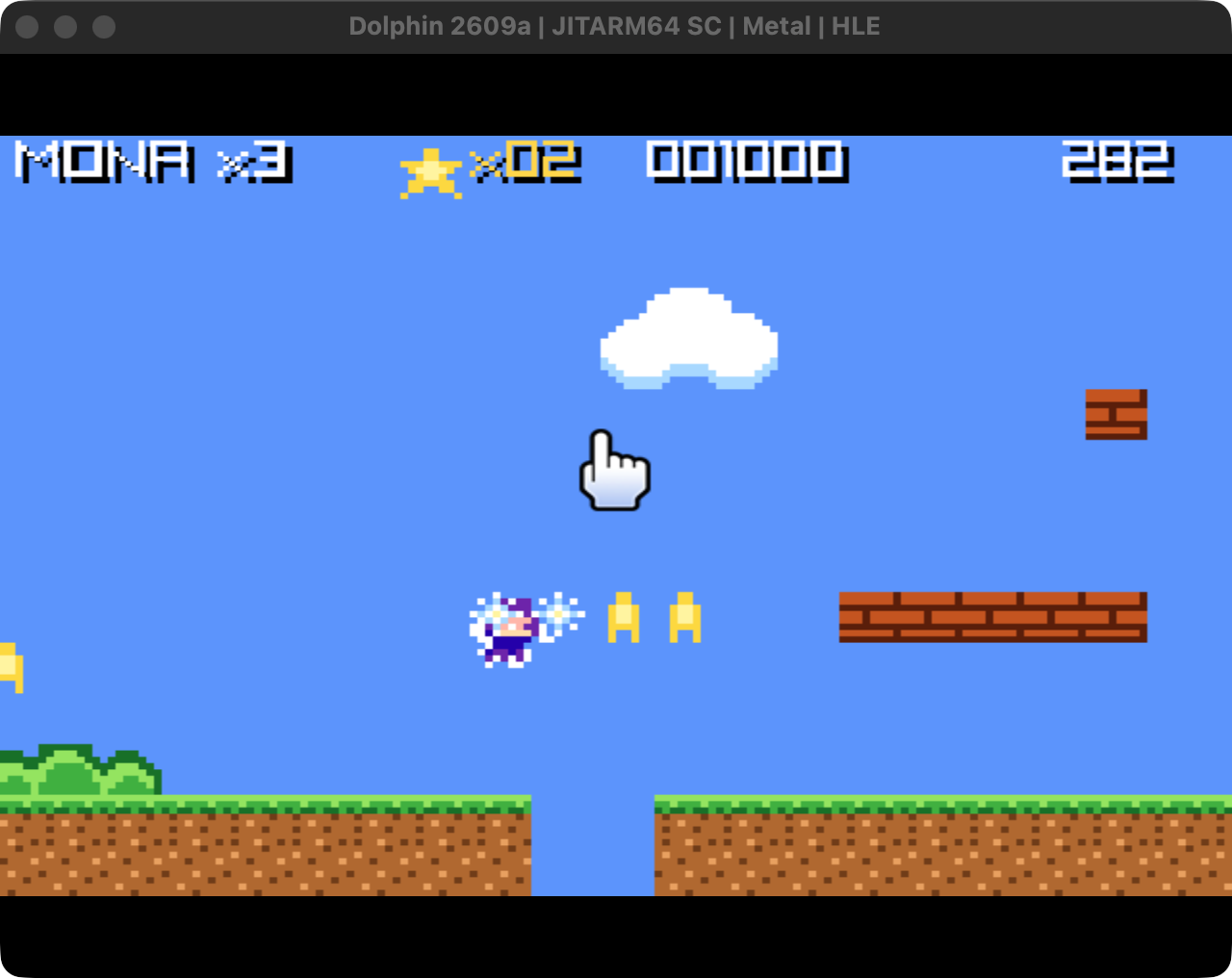
Super Mona is a 32-stage platformer that Martin Woodward wrote in MicroPython for the GitHub Universe 2026 badge. Here it runs on the Wii as a Clojure program on jolt, with the remote held sideways. It plays, and it misses the 60 fps budget on busy frames. Every number on this page comes from Dolphin with MMU emulation on. No jolt build has run on a physical console yet, so read them as Dolphin's, not the Wii's.
| Title | Play |
|---|---|
 |  |
Where it came from
The game is martinwoodward/super-mona (MIT). Its README describes eight worlds of four stages, each world shaped like a classic overworld, underground, sky and castle run:
| World | -1 | -2 | -3 | -4 |
|---|---|---|---|---|
| 1 | HELLO WORLD | SERVER ROOM | SKY BRIDGE | FIREWALL |
| 2 | PULL REQUEST | OVERFLOW | CLOUD DEPLOY | CONFLICT |
| 3 | CLONE | FORK | PUSH | PULL |
| 4 | ACTION | TRIGGER | PRE-PROD | PROD |
| 5 | BUG BASH | STACK TRACE | BREAKPOINT | SEGFAULT |
| 6 | CONTAINER | KERNEL PANIC | EDGE CACHE | DEADLOCK |
| 7 | CLONE | STASH | PR | MERGE |
| 8 | PLAN | BUILD | TEST | SHIP-IT |
We kept the badge's rules and stages and rewrote the code. The physics in jolt-mona/src/mona/rules.clj is transcribed from the badge's game.py, and the 32 stages in levels.clj are reproduced from its levels.py. The Mona sprites derive from the badge's Flappy Mona (badger/home, MIT). The attribution is at the bottom.
Playing it on the Wii
Hold the remote sideways, like an NES pad.
| Remote | Action |
|---|---|
| D-pad | Move. Down crouches when Mona is big |
| 2 | Jump. Hold it for a higher jump |
| 1 | Run. Hold to carry a shell, release to throw it |
| + | Pause. Left and Right switch between PAUSED, MAP, ITEMS and HERO |
| Home | Quit |
Whichever remote presses 2 on the title screen drives that game. After a game ends, any remote can start the next one. The high score is saved as mona_high in settings.txt beside boot.dol.
jolt build:jolt-mona
jolt run:jolt-mona            # the title demo plays stage 1-1
jolt run:jolt-mona-wiimote    # a scripted remote: 2 every second, 1 and D-pad down held
jolt play:jolt-mona           # you play with the keyboard
jolt play:jolt-mona uses the play-sideways profile: Left and Right Arrow move, Up and Down Arrow are the pad's up and down, X is 2, Z is 1, Return is + and Escape is Home. The profiles are described in Wiimote input.
How it's built
flowchart TD
  levels["mona.levels<br/>32 stages, checked against the Python"] --> rules["mona.rules<br/>physics, enemies, items"]
  rules --> app["mona.app<br/>title, intro, play, pause, demo bot"]
  app --> main["mona.main<br/>frame loop"]
  draw["mona.draw"] --> main
  main --> gfx["wii.gfx"]
  gfx --> shim["jolt-gfx/jolt_gfx.c"]
  shim --> raylib["raylib 6.0, SDL2, OpenGX"]
The game is jolt-mona/src/mona/{rules,levels,draw,app,main}.clj. It sits on the same pipeline as Balloon Pop in Clojure: the graphics pack, the shim registered at link time, and one defcfn per C function. Where Balloon Pop uses plain maps, the Mona records have ^double fields, because the cast work in that page showed what an unhinted double costs on 32-bit Chez. The tile grid is a byte array, the one mutable structure in the game. Everything else is a functional update.
What the shim gained
The shim in jolt-gfx/ took three additions, plus a counter.
- Sprites. The sprite sheets are embedded as PNG bytes in
jolt-gfx/mona_assets.h, whichscripts/png-to-cgenerates fromjolt-mona/assets.jg_spritetakes a cell, a position and in-place flips, andjg_scalemultiplies everything by 4, so the badge's small sprites fill a TV. - Tile layers.
jg_tiles_loadhands the stage to C once,jg_tile_setchanges one cell (a broken brick, a bumped block), andjg_tiles_drawdraws the visible 23 by 15 window from a buffer on the C side.jg_tiles_mapdraws the minimap on the pause MAP page. - Settings.
jg_setting_getandjg_setting_putsit overexamples/common/settings.c. That file now prints integral values exactly, where%ghad cut them off from 1,000,000 up. jg_callscounts shim crossings per frame, so the frame summary can say how many a frame needed.
The reason for batching is in the Balloon Pop page: a crossing costs 4 to 18 us and a write through memory costs more, so one call that draws a whole window beats hundreds of calls that draw a cell each. The tile window is that batch.
Build flags and the heap
jolt build:jolt-mona needs jolt at or past jolt-lang/jolt#1514. It builds with --closed-world --boot small --no-trace, passed through JOLT_BUILD_FLAGS. The reason is the heap. A 17.5 MB .dol ran out of jolt's heap at boot, and the 11.9 MB one boots. jolt 0.8.28 made a traced build about 1 MB bigger again (13.06 MB, out of memory at boot), so the build also turns tracing off, which gives 12.35 MB. A crash report then names fewer frames. The heap arithmetic is in Balloon Pop in Clojure.
What moved and what did not
The badge pre-renders each stage into one big image and scrolls it. OpenGX has no framebuffer objects, so that image does not exist here. The shim draws a 23 by 15 window of tiles from the C-side buffer every frame instead. The badge's vector fonts became raylib's default font. The stages, the physics, the enemies, the items and the pause pages are the badge's.
Sound
Super Mona has chip-style sound: seventeen effects and ten original tunes, synthesised in the C shim and played through libogc's AESND. The badge has no sound to port, so all of it is new. The recording is a one-minute Dolphin capture with its audio, made by jolt demo:jolt-mona-video, which writes docs/demos/super-mona-sound.mp4 with the debug stamp hidden. Nothing here has run on the real console yet, so every claim below is Dolphin's.
The synthesiser
jolt-gfx/snd.c has seven voices: two pulse and a triangle and a noise voice for the music, then two pulse voices and a noise voice for effects. Each voice has an ADSR envelope, and an effect is a short list of frequency slides. One AESND stream voice at 48 kHz carries the mix. Its callback renders a fixed 288 frames per call from the audio interrupt, using integer maths on static state only: no allocation, no floats, no calls into Chez.
A four-track sequencer plays the tunes (pulse 1, pulse 2, triangle, and drums on the noise voice). It can loop, pause on a row, and change tempo from the next row. The core is plain C99, so jolt test builds and checks it with a host cc. The Wii glue sits behind __wii__. snd_wii.c puts the stream on AESND, and jg_snd_register in jolt_snd.c registers Super Mona's exports the same way register_all registers the graphics ones. Star Catcher and Shake Race link the same snd.c and snd_wii.c, and their tunes live in examples/music/.
The note language
The note language is chip.music (jolt-gfx/src/chip/music.clj), and Super Mona's tunes are data in jolt-mona/src/mona/music.clj. Each pattern is two bars of 4/4 on 32 rows, and a track is a string of notes, each with an optional : and row count: g4:2 is G in octave 4 held for two rows, - is a rest and a bare note is one row. Drums are k, s and h. A pattern is a map of its four tracks, the two pulse voices, the triangle and the noise channel. This is the first pattern of the title tune:
{:p1 [:brass "d4:2 g4:2 d5:4 b4:2 d5:2 g5:4 f#5:3 e5 d5:4 b4:2 e5:2 d5:4"]
 :p2 [:harm "b3:8 d4:8 c4:8 a3:4 f#3:4"]
 :tri [:bass "g2:2 -:2 g2:2 d2:2 g2:2 -:2 g2:2 d2:2 d2:2 -:2 d2:2 a2:2 d2:2 -:2 d2:2 f#2:2"]
 :noise "k - - - s - h - k - k - s - h h k - - - s - h - k - k - s - h h"}
A song names its patterns in :order, a tempo in rows per minute and the order index to loop back to. The ten songs are title, day, dusk, cloud, cave, castle, clear, die, over and win.
From note data to C
scripts/music-to-c reads mona.music and writes jolt-gfx/mona_music.h, the tables the shim links. scripts/music-to-c starcatcher and shakerace do the same for the other two games, writing examples/<game>/<game>_music.h. Each header is committed. A jolt test gate regenerates it and fails when the committed copy is stale, so editing a tune means running scripts/music-to-c and committing both files. The Makefile makes jolt_snd.o depend on the header, so a changed tune rebuilds the shim.
When things play
mona.sound holds the cue rules as pure functions of the app map, and mona.main sends the result to the shim each frame.
- Title: the title tune loops. Intro: silent. Over: the game-over tune plays once. Win: the win tune loops.
- Play, pause and demo: the stage theme's tune loops (
day,dusk,cloud,caveorcastle). Pause holds the row and releases the voices, and resuming picks up at the same row. - Hurry-up: when
time-leftdrops under 100 the tempo goes to 125 percent. - Death: the
diejingle plays once on the die event, and effects stay silent while the hero is dying so the jingle owns the sound. - Clear: the
clearfanfare starts at the flag and keeps going through the castle walk and the tally, because the world has a:castlestate between the flag and the tally. - Effects: one per rule event that has a recipe. There are seventeen, including
star, which the first design table missed. Thedieeffect is a silent step, since the jingle is music.
The mute toggle
- on the title turns the sound off and on, and the title shows SOUND OFF while it is off. The choice is saved as mona_sound in settings.txt (mona_sound=0 is off) and survives a reboot. Muting sets both volumes to 0, so the synthesiser keeps running and the stats stay comparable.
The log
The loop prints sound init=<0|1> at boot, sound on or sound off when the setting is applied, and music <song|none> whenever the tune changes. The 300-frame frames line gains four fields:
| Field | Meaning |
|---|---|
snd-peak | the largest sample rendered since the last summary |
sfx | effects triggered, saturating at 255 |
snd-cb | stream callbacks run, saturating at 63 |
snd-music | the largest sum of the four music voices, effects excluded |
Listening
jolt run:jolt-mona-audio boots the game in Dolphin with -C Dolphin.DSP.DumpAudio=True, picks the loudest dump and prints its path and peak. The 48 kHz voice is dspdump1.wav under the profile's Dump/Audio (.dolphin-auto/idle/Dump/Audio). The plain dspdump.wav is Dolphin's silent 32 kHz mixer. -C Dolphin.Movie.DumpFrames=True dumps PNG frames, which jolt demo:jolt-mona-video joins with the audio, because this Dolphin build has no video encoder of its own. jolt run:jolt-mona-mute presses - on the title and prints whether the game muted and saved.
What jolt verify checks without a listener
jolt verify can't hear anything, so it reads the shim's stats. Three gates cover sound, and 18 checks pass with them:
jolt-mona-sound: in the demo run,snd-musicis above 3000 in some window (music rendered) andsfxabove 0 (effects triggered).jolt-mona-sound-wiimote: the same two conditions in the scripted-remote run, so the rules' events reach the shim from real input.jolt-mona-mute: a run with-pressed on the title logssound offand savesmona_sound=0, and a second boot reads it back and starts muted.
A passing gate proves that samples were rendered, not that they sound good. The tunes and effects are tuned from the numbers and need an ear on the console.
The numbers
Measured on this branch in Dolphin, single runs (jolt-mona/MEASUREMENTS.md has the setup).
| Window | 601-900 | 901-1200 | 1201-1500 | 1501-1800 | 1801-2100 |
|---|---|---|---|---|---|
| Work median before sound (ms) | 15.0 | 14.0 | 12.8 | 11.8 | 10.9 |
| Work median with sound (ms) | 14.8 | 14.8 | 13.2 | 12.2 | 11.3 |
Sound cost between minus 0.2 and plus 0.8 ms a frame in the demo, within the run-to-run spread of a few tenths. Stage music renders at an snd-music of 7304 to 7578 per window. The shim's static footprint is 3,344 bytes of data plus bss, and the audio dump's loudest peak was 7718 of 32767.
The .dol grew from 11,872,224 to 12,040,896 bytes with sound. That is the heap's margin: requiring all of mona.music on the Wii path made it 12,259,456 bytes and the boot died with "out of memory" before the first line. So mona.music (the note parser and the data) is host-only, and the Wii build may require only mona.music-ids. The margin is under about 240 KB of .dol and its lower bound is unknown. The shim's jolt_gfx: heap line can't show the headroom: its "fallback ... free 0 + 0" means the fallback heaps were not built, not that they are empty. A console boot is the real test.
A deviation from the design
The design promised a per-call render under a budget counted in rendered frames, and no test checks that. It holds by structure, since each callback renders a fixed 288 frames, but it is a property of the code and not of a test.
The tests
jolt test runs four namespaces for the game, all on the Mac under jolt -A:test.
mona.levels-testcompares every stage byte for byte with a dump of the Python.scripts/mona-goldenmakes the dump from the badge'slevels.py, and the result isgolden_levels.edn. A second test has the demo bot finish every one of the 32 stages, at 30 and at 60 Hz.mona.rules-testmirrors the badge's own rule tests: stomping a bug, a shell pickup and throw, a held jump going higher, a brick that breaks only when Mona is big, 100 stars giving a life, and falling off the stage.mona.app-testwalks the title, the intro, play and the pause pages, a death and a clear, and the second game started from another remote.mona.draw-testpins the draw calls of recorded states (draw_golden.edn), including a left-facing player flipped in place.
jolt verify also boots the game in Dolphin. It checks the demo, the scripted jump, and that the loop is still printing frame summaries late in the run.
The measurements
The game prints one summary line every 300 frames. Work is update plus draw. Dropped counts frames whose interval ran past 20 ms. Calls is shim crossings per frame. jolt-mona/MEASUREMENTS.md has every window and the setup (jolt v0.8.23-429, Dolphin, MMU on).
| Run | Window | Work median (ms) | Dropped per 300 | Calls |
|---|---|---|---|---|
| Scripted, first screen | each of 6 windows | 6.5 to 6.6 | 1 to 3 | 28 to 29 |
| Demo, title | frames 1-600 | 6.1 | 1 to 2 | 27 |
| Demo, stage 1-1 | frames 601-900 | 18.2 | 53 | 32 |
| Demo, stage 1-1 | frames 901-1200 | 16.5 | 34 | 33 |
| Demo, stage 1-1 | frames 1201-1500 | 12.8 | 2 | 31 |
| Demo, stage 1-1 | frames 1501-1800 | 7.7 | 1 | 28 |
Play on the first screen costs 6.5 ms of work a frame. The demo bot goes deeper into stage 1-1, where more enemies are alive, and the update alone takes 12.9 ms in its worst window against 2.9 ms in its lightest. Drawing is flat at 4 to 5 ms everywhere, title screen included, and 28 to 32 crossings a frame cannot account for that. The tile window in C is the likelier cost, though only a run with the stub-draw pack would split the two.
The spec's bar was a work median of 12 ms with no work frame over 16.7 ms. The scripted run passes the median and the demo misses it in four of its windows. Both fail the worst-frame limit, because every run shows stalls of 280 to 850 ms. A run with jolt's collector log on (scripts/dkp make -C jolt-gfx EXTRA_CFLAGS=-DJG_GC_LOG) shows 28 collections in 45 s, none of them full, the longest 10 ms and 29 ms in total (two of them before jg_init), so the stalls are not the collector. One 6 ms collection sits inside the first stall, none inside the others. They fall on start-up and the first title frames and on the two stage loads (23.153 s and 46.193 s, from that run's log and not kept in the extract).
The fallback ladder
The ladder is in order, and which rung to climb is the user's decision. No rung has been tried yet.
| Rung | What | State |
|---|---|---|
| 0 | An algorithmic fix in Clojure for the enemy update, which scans linearly and rebuilds vectors per enemy, so it is O(N2) | Not done |
| 0b | The collector: measured with JOLT_GC_LOG, 29 ms over a 45 s run and no stall inside it, so its options (static boot data, less allocation per frame, a forced collection in the intro) are moot for the stalls | Measured |
| 1 | Batched sprite calls | Not done, buys little |
| 2 | Enemy and item physics in C | Not done |
| 3 | The renderer in C | Not done |
Attribution
jolt-mona/assets and the game's rules and stages come from Super Mona by Martin Woodward, MIT license (github.com/martinwoodward/super-mona), ported from MicroPython to Clojure. The Mona sprites derive from the badge's Flappy Mona (badger/home, MIT). The MIT copyright and permission notice is in jolt-mona/LICENSE.super-mona, and NOTICE at the root of the repository carries the same credit.