raylib on the Wii
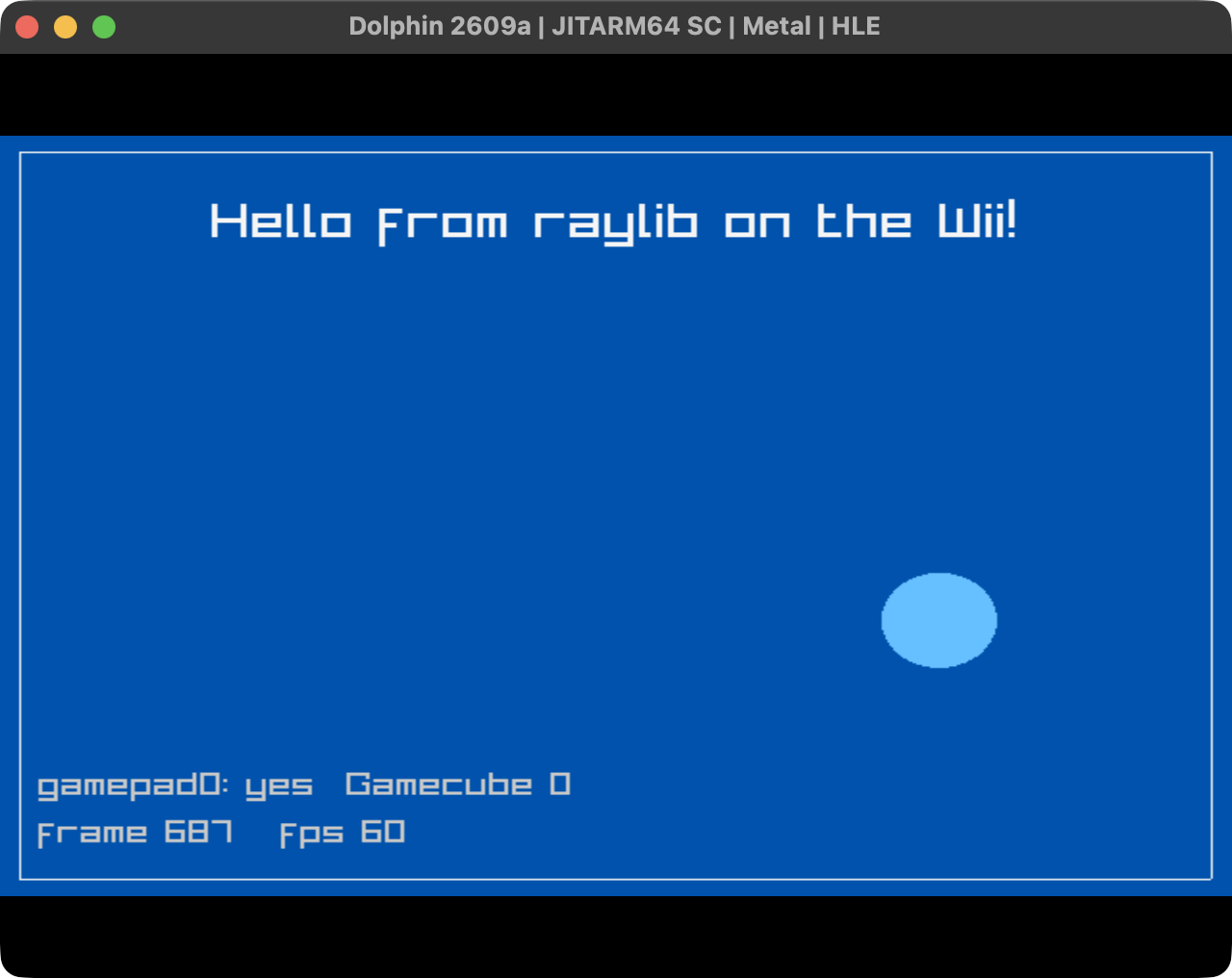
Stock raylib 6.0 runs on the Wii with no source changes. The trick is that devkitPro already ships the two layers raylib needs underneath it.
The stack
examples/hello/main.c          ordinary raylib code
vendor/raylib (6.0)            PLATFORM_DESKTOP_SDL + GRAPHICS_API_OPENGL_11
wii-sdl2 2.28.5                windows, input, timing on libogc
wii-opengx 0.17.0              OpenGL 1.x implemented over the Wii's GX GPU
libogc 3.2.1                   the Wii's system library
flowchart TD
  app["Your app: ordinary raylib code"] --> rl["raylib 6.0<br/>PLATFORM_DESKTOP_SDL + GRAPHICS_API_OPENGL_11"]
  rl -->|"window, events, timing"| sdl["wii-sdl2 2.28.5"]
  rl -->|"fixed-function GL"| gx["wii-opengx 0.17.0"]
  sdl --> ogc["libogc 3.2.1"]
  gx --> ogc
  ogc --> hw["Wii: GX GPU, Wiimotes, SD card"]
raylib picks its platform and its renderer at compile time. Its SDL platform (rcore_desktop_sdl.c) asks SDL for a window and a GL context, and its OpenGL 1.1 renderer only uses fixed-function GL, which is what OpenGX implements. At startup raylib reports:
INFO: GL: OpenGL device information:
INFO:     > Vendor:   opengx
INFO:     > Renderer: libogc
INFO:     > Version:  1.5
INFO: PLATFORM: DESKTOP (SDL2): Initialized successfully
raylib-wii/Makefile compiles rcore, rshapes, rtextures, rtext and rmodels into libraylib.a. raudio is left out for now. raylib's audio goes through miniaudio, and we haven't tried building it against libogc yet.
The one build change: raylib bundles a Windows dirent.h under src/external/, so putting external/ on the include path makes it shadow newlib's real one and the build fails looking for io.h. raylib's own includes already name external/... explicitly, so the fix is to leave that directory off the include path.
I found no earlier raylib port for the Wii. The pieces were all there, and it looks like nobody had joined them up.
The keyboard crash
The first run looked fine in Dolphin, but with MMU emulation on it crashed every frame with a null read inside libogc's thread queue. The stack, decoded with addr2line:
KEYBOARD_GetEvent        libwiikeyboard/keyboard.c:637
OGC_PumpKeyboardEvents   SDL2-2.28.5/src/video/ogc/SDL_ogckeyboard.c:32
SDL_PumpEventsInternal   SDL_events.c:927
SDL_WaitEventTimeout     SDL_events.c:1097
PollInputEvents → EndDrawing → main
SDL's video init calls KEYBOARD_Init(NULL) and ignores what it returns. When that init fails early (USB_Initialize or USBKeyboard_Initialize not returning IPC_OK, which is what happens in Dolphin), libwiikeyboard skips __lwp_queue_init_empty(&_queue). SDL still calls KEYBOARD_GetEvent every frame, and that walks a queue that was never set up.
libogc's master has the same code, checked 2026-11-03.
raylib-wii/wii_shim.c fixes it at link time, without patching either library. The app links with -Wl,--wrap=KEYBOARD_Init -Wl,--wrap=KEYBOARD_GetEvent, and the shim remembers whether init succeeded:
s32 __wrap_KEYBOARD_GetEvent(keyboard_event *event)
{
    if (!kbd_ready) return 0;
    return __real_KEYBOARD_GetEvent(event);
}
One linking detail: the shim is passed as an object file (raylib-wii/build/wii_shim.o), not as a member of libraylib.a. The __wrap_ symbols are only referenced from SDL, which comes later on the link line, so an archive member would never get pulled in.
Whether KEYBOARD_Init also fails on a real Wii with no USB keyboard attached is one of the things to check on hardware. The shim is harmless either way.
SDL's main wrapper (needed for Wiimotes)
devkitPro's SDL for the Wii brings its own main (src/main/wii/SDL_wii_main.c in their SDL fork). It reloads the preferred IOS, calls WPAD_Init(), hooks the power and reset buttons, starts the USB mouse and mounts the SD card, then calls the application as SDL_main. SDL's joystick code relies on that: it says "We don't call WPAD_Init() here, since it's already been called by SDL_main".
sequenceDiagram
  participant HBC as Homebrew Channel
  participant SM as SDL's main (SDL_wii_main.c)
  participant App as Your main, renamed SDL_main
  participant RL as raylib
  HBC->>SM: launch boot.dol, argv[0] = its path
  SM->>SM: WPAD_Init, power and reset hooks
  SM->>SM: fatInitDefault (mounts sd: and usb:)
  SM->>App: SDL_main(argc, argv)
  App->>RL: InitWindow, then the game loop
A raylib app defines its own main, so it has to opt in with SDL's standard include, or the Wiimotes never initialise:
#include "raylib.h"
#include <SDL2/SDL_main.h>    // renames main to SDL_main

int main(int argc, char *argv[])
examples/hello and examples/balloons both do this. We found it through Balloon Pop, see Balloon Pop.
Writing your own raylib app
Make a directory next to hello, put a main.c (and optionally a meta.xml) in it, then:
scripts/dkp make -C examples APP=myapp
A few Wii-specific notes:
- The screen is 640x480.
InitWindow(640, 480, ...)matches it. - Include
<SDL2/SDL_main.h>and useint main(int argc, char *argv[])(see above), or no Wiimote will ever connect. - For the Wiimote pointer, tilt or shake, read the remotes with libogc's WPAD through
examples/common/wiimote.c, the way the games do. SDL merges every remote's pointer into one mouse. See Wiimote input. - Call
SYS_STDIO_Report(true)at the start ofmainif you wantprintfand raylib's log in Dolphin's log. raylib apps draw with the GPU, so this doesn't interfere with the screen. The text-console apps need the tee described in Jolt on the Wii instead.