Chez Scheme on the Wii
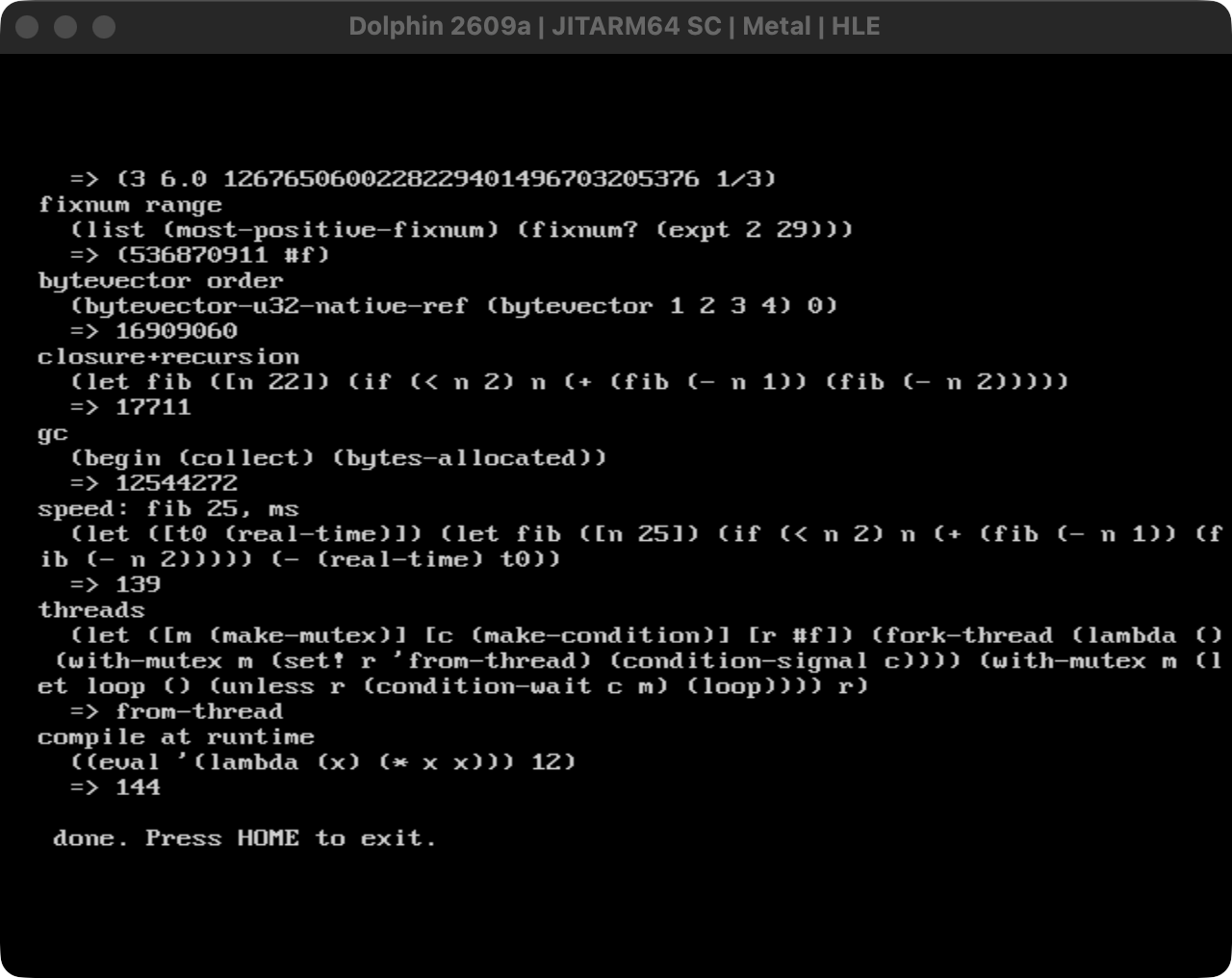
Chez Scheme normally compiles to native machine code, and it has a PowerPC backend. That backend targets Linux and macOS, though, and it generates code at run time. A Wii has neither an OS nor a reason to want a JIT. Chez's portable bytecode targets fit much better: the compiler emits bytecode for an abstract machine, and a C interpreter in the kernel runs it. The kernel is plain C, so devkitPPC can compile it.
The machine type we use is tpb32b:
t | threaded (Chez's thread support compiled in, which jolt needs) |
pb | portable bytecode |
32 | 32-bit words and pointers |
b | big-endian, matching the Wii's PowerPC |
tpb32b is listed in Chez's s/cmacros.ss. As far as we can tell, nobody had run it on big-endian hardware before. raylib-ios runs jolt on tpb64l for a similar reason (iOS forbids generating code at run time), and jasalt's WASM experiment runs it on tpb32l.
Building it
jolt chez:setup    # once
jolt build:chez
scripts/setup-chez clones ~/dev/ChezScheme locally into .work/ChezScheme, checks out v10.4.1 (the Chez that jolt is built on), applies patches/chez-wii.patch, builds a Mac Chez, and then runs make bootquick XM=tpb32b. That last step produces the tpb32b boot files, petite.boot (2.1 MB) and scheme.boot (1.0 MB), plus the scheme.h and equates.h the kernel compiles against.
flowchart LR
  chez["~/dev/ChezScheme"] -->|"scripts/setup-chez:<br/>v10.4.1 + chez-wii.patch"| host["Mac Chez"]
  host -->|"make bootquick XM=tpb32b"| boots["petite.boot, scheme.boot<br/>scheme.h, equates.h"]
  csrc["Chez kernel C source"] -->|"devkitPPC"| kernel["libkernel.a"]
  boots -->|".incbin in boot_data.S"| dol["chez.dol"]
  kernel --> dol
  dol -->|"Sregister_boot_file_bytes<br/>at start-up"| run["Chez running on the Wii"]
chez-wii/Makefile then compiles the kernel's C files with devkitPPC into libkernel.a and links the test app. The boot files go into the .dol itself through .incbin in boot_data.S, and main.c hands them to Chez with Sregister_boot_file_bytes, so no filesystem is involved.
The kernel patch
patches/chez-wii.patch adds about 130 lines to seven files, all under #if defined(__wii__):
version.hgets a__wii__OS branch modelled on the existing__EMSCRIPTEN__one:mallocinstead ofmmap, no dynamic loading, no curses or X11, and newlib'sstruct stattime fields. It also adds__wii__to the big-endian architecture test. That test checks__powerpc__, which devkitPPC doesn't define (it defines__PPC__,PPCand__wii__), so without the addition Chez would silently assume little-endian.types.h: newlib hassetjmp/longjmpbut not the underscore-prefixed variants.stats.c: newlib'sstruct tmhas notm_gmtoffortm_zone. The Wii clock has no time zone anyway, so it reports UTC.schsig.c: libogc has no POSIX signals, so the handler setup is skipped.expeditor.c: the expeditor is the REPL line editor, and it needs a terminal. It's compiled out, butscheme.bootstill binds its C entry points when it loads, so the patch registers all thirty names against one stub that answers "not a terminal".pb.handpb.c: the bytecode interpreter's double loads and stores (ld double,st doubleand the foreign-call arena moves) are plain*(double *)accesses. The Wii's 750 raises an alignment exception on a floating-point load or store whose address is not word-aligned, where Dolphin and the Mac accept it, and the first run on a console found Scheme code reading a double from a byte buffer at an odd offset during boot. On the Wii those accesses take the direct path when the address is word-aligned and go through two word copies otherwise; the runtime prints how often that happened at exit (pb: unaligned double loads N stores M).
Thread-local storage
With the patch, Chez linked and then stopped at startup with "Function not implemented". The failing call was pthread_key_create.
devkitPro's newlib does provide pthreads, implemented in libsysbase on top of hooks a platform library is meant to fill in. libogc 3.2.1 fills in the thread and condition variable hooks but not the four TLS ones (__syscall_tls_create, _set, _get, _delete), or __syscall_thread_detach. They're weak symbols, so nothing fails at link time, and pthread_key_create just returns ENOSYS.
chez-wii/ogc_tls.c provides them: a fixed table of 64 threads by 32 keys, looked up by LWP_GetSelf(), with interrupts disabled around each access. It's deliberately simple, and that comes with limits:
- Rows aren't freed when a thread exits, and libogc reuses thread handles, so a new thread can briefly see an old thread's values. Chez sets its own key at the start of every thread it creates, so this doesn't affect it.
- Destructors are recorded but never run.
pthread_detachis a no-op.
POSIX stubs
The kernel also references fork/exec-style process calls, signals, getpwnam, iconv and getrusage, none of which libogc has. chez-wii/posix_stubs.c provides them. Most return an error, so Scheme code that reaches one gets an ordinary exception. getrusage returns wall-clock time as CPU time, because Chez reads it at startup to set up cpu-time.
What works
chez-wii/main.c evaluates a list of expressions, all through Scheme's own reader and eval. In Dolphin with MMU emulation on:
(scheme-version)                        => "Chez Scheme Version 10.4.1"
(machine-type)                          => tpb32b
(list (+ 1 2) (* 1.5 4) (expt 2 100) (/ 1 3))
                                        => (3 6.0 1267650600228229401496703205376 1/3)
(list (most-positive-fixnum) (fixnum? (expt 2 29)))
                                        => (536870911 #f)
(bytevector-u32-native-ref (bytevector 1 2 3 4) 0)
                                        => 16909060
(begin (collect) (bytes-allocated))     => 12544272
fib 25, ms                              => 139
threads (mutex + condition variable)    => from-thread
((eval '(lambda (x) (* x x))) 12)       => 144
16909060 is #x01020304, so bytes are read in big-endian order. The fixnum ceiling is 229 - 1, as on any 32-bit Chez. fib 25 makes 242,785 calls, so 139 ms is about 1.7 million calls a second on a 729 MHz CPU. The console itself took 109 ms for the same line (2026-11-06), about 2.2 million calls a second, so Dolphin runs this interpreter a little slower than the real thing.
Output on the TV and in the log
The test app prints every line twice: to the TV through libogc's text console (stdout), and to the debug UART (stderr), which Dolphin logs. Calling SYS_STDIO_Report(true) would send stdout to the UART instead of the TV, and the screen would stay black on a real Wii, so the app uses SYS_STDIO_Report(false) and writes to both itself.