Jolt on the Wii
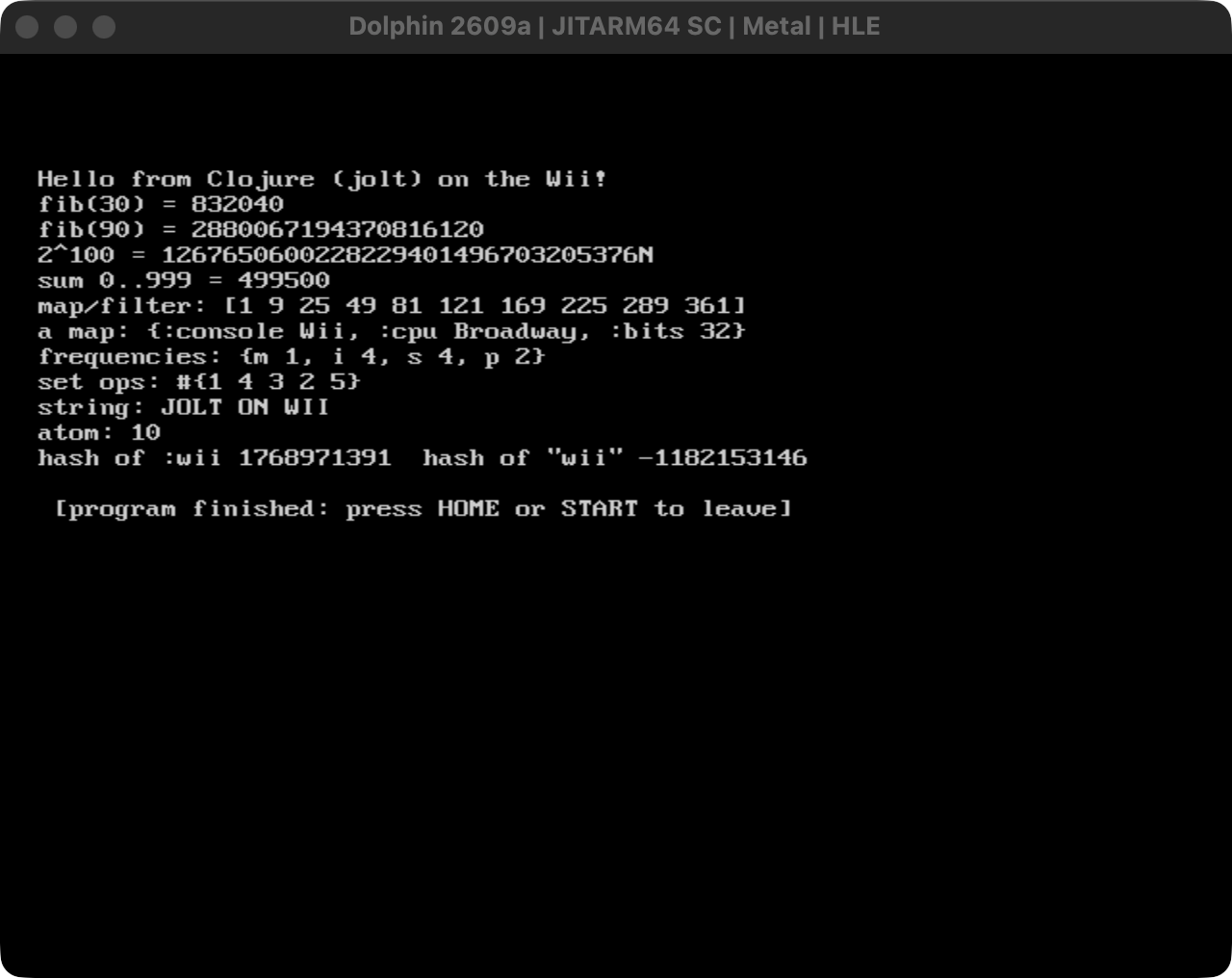
jolt compiles Clojure to Chez Scheme, and jolt build --target <machine> already cross-compiles for any Chez machine it has a "target pack" for. Once Chez ran on the Wii, the question was whether that pipeline would carry a Clojure program across too. It does, after two fixes to assumptions jolt makes about 32-bit machines.
jolt build:chez         # also builds the runtime objects jolt programs link
jolt pack               # .work/pack-tpb32b
jolt build:jolt-hello
jolt run:jolt-hello
jolt-hello/src/hello/core.clj exercises the parts of Clojure most likely to break on a new machine: long and bignum arithmetic, persistent maps and sets, lazy sequences, string functions, atoms, and hash, whose values jolt pins to the JVM's. Its output in Dolphin matches the Mac build byte for byte, and jolt verify checks that against jolt-hello/expected-output.txt.
How the build works
flowchart TD
  clj["src/*.clj"] --> emit["jolt: runtime.ss + app-*.ss"]
  emit --> xc["Mac Chez + the pack's xpatch<br/>compile to tpb32b bytecode"]
  xc --> boot["jolt.boot (petite.boot + app)<br/>as vfasl, written out as a C array"]
  boot --> link["scripts/wii-cc: main.c + libkernel.a<br/>+ wii_runtime.o, ogc_tls.o, posix_stubs.o + libogc"]
  link --> elf["jolt-hello.elf"] -->|"elf2dol"| dol["jolt-hello.dol"]
  pack[".work/pack-tpb32b<br/>(scripts/make-pack)"] -.-> xc
  pack -.-> link
jolt build --target tpb32b --target-pack <pack>:
- Emits the jolt runtime and the app as Chez source (
runtime.ss,app-*.ss), the same as a native build. - Starts a fresh Mac Chez,
(load ...)s the pack'sxpatch(Chez's cross compiler fortpb32b), and compiles everything totpb32bbytecode. - Combines the pack's
petite.bootand the compiled code into onejolt.boot, converts it to vfasl (9.4 MB for jolt-hello), and writes it out as a C array. - Links a generated
main.cagainst the pack'slibkernel.ausing$JOLT_TARGET_CCand the flags in the pack'slink-libs.
scripts/make-pack assembles the pack from .work/ChezScheme and chez-wii/build. scripts/wii-cc is $JOLT_TARGET_CC: devkitPPC in Docker, with the Wii machine flags added. link-libs names three objects from chez-wii ahead of the libogc libraries:
wii_runtime.o: a constructor that brings up video and the text console before jolt'smainruns, tees stdout to the TV and the debug UART, and waits for HOME or START at exit so the output stays on screen.ogc_tls.oandposix_stubs.o: the same thread-local storage hooks and POSIX stubs the Chez test app uses (see Chez Scheme on the Wii).
scripts/jolt-wii-build runs jolt build, then elf2dol, then lays out build/sd/apps/<name>/.
Fix 1: the hash engine picked the 64-bit arm
The first run died during runtime init:
Exception: variable murmur3-seed is not bound
jolt's hash engine (host/chez/hasheq.ss) has two versions of its arithmetic. On a 64-bit Chez every 32-bit hash value is a fixnum, so it uses unchecked #3%fx operations. On a 32-bit Chez they can be bignums, so it uses generic ones. define-width-op picks between them when the code is expanded, by asking (fixnum? #xFFFFFFFF). Its own comment says the catch:
The test runs on the COMPILING Chez, which for a native build is the target. Cross-compiling to a target narrower than the host would have to consult the target's fixnum width here instead.
A cross build compiles on the 64-bit Mac, so the Wii got the 64-bit arm, and unchecked fixnum operations on bignums give garbage rather than an error. jolt already has an override for testing the narrow arm on 64-bit machines, JOLT_NARROW_HASH=1, and setting it gets past init.
Fix 2: checked fx operations on int-sized values
The next run failed with:
Exception in fx>=?: -2147483648 is not a fixnum
This one is in jolt's CHANGELOG entry for #801, which fixed the hash engine for 32-bit Chez: "Other host code still applies checked fx ops to int-width values, which raise rather than corrupt." A grep of the generated runtime finds about a dozen, for example:
(if (and (fx>=? k -2147483648) (fx<=? k 2147483647)) k (int32-low k))
(if (fx>=? i #x80000000) (fx- i #x100000000) i)
On a 32-bit Chez the fixnum ceiling is 229 - 1, so -2147483648 isn't a fixnum and the check raises.
The fix replaces the checked fx operators (fx+, fx>=?, fxand and the rest) with their generic equivalents for this compile. Generic and fx operations agree whenever the arguments are fixnums, so code that was already correct behaves the same. The explicit #3%fx primitives in the hash engine aren't touched, and with fix 1 those are on the narrow arm anyway.
Where the fixes live
In jolt, since jolt-lang/jolt#1514 (merged 2026-11-05, the first release after 0.8.23 carries it). build.ss has bld-narrow-target?, which recognises the i3, arm32, armv7, ppc32 and pb32 machine families. For those targets the generated compile script sets JOLT_NARROW_HASH and defines the fx-to-generic aliases right after loading the xpatch. Native builds and 64-bit cross builds generate exactly the script they did before.
So this repo needs a jolt at or past that merge and nothing else: the pack's xpatch is Chez's own cross patch, and scripts/jolt-wii-build sets no environment variable. jolt doctor checks the installed jolt's version. Until then the repo carried the same two fixes itself, as a wrapper xpatch that defined the aliases plus JOLT_NARROW_HASH=1 in the build script; a jolt older than the merge fails at init on the Wii with "variable murmur3-seed is not bound".
jolt 0.8.29 hashes differently on the Wii
jolt 0.8.29 (released 2026-11-23) boots and runs everything here, but on the Wii its string and keyword hashes no longer match Clojure's. jolt-hello's last line is how jolt verify caught it:
| Mac, and JVM Clojure | Wii build, jolt 0.8.29 | |
|---|---|---|
(hash :wii) | 1768971391 | 582562539 |
(hash "wii") | -1182153146 | 104228450 |
Maps and sets still work, because the program agrees with itself. Only the values moved. The change came from one jolt commit that made the 32-bit hash multiply a single multiplication. On a 64-bit Mac the operands are fixnums. On the Wii they're bignums, and the cross-compiled build gets some of those products wrong. Splitting the multiply again, as it was before, brings the right values back, and jolt verify passes 18/18 with that change. The fix is jolt-lang/jolt#1831. Until a release carries it, build the Wii games with jolt 0.8.28.
The multiply underneath is still wrong for Clojure code. On the Wii build, (* (bigint -862048943) (bigint 461845907)) comes out as -1585479290398231171 instead of -398133775958226301, while Chez evaluating the same product on the console gets it right. Until that's fixed in jolt, don't trust bigint multiplication in a jolt program on the Wii.
The console tee, and a libogc surprise
The first jolt-hello screenshot showed only the last line of output, with a stray character from a longer line under it. The output in Dolphin's log was fine. Logging every write showed jolt sending clean \n-terminated lines, so something between the tee and the screen was changing them.
It turned out to be libogc's UART writer. WriteUARTN in libogc/exi.c (line 1038 in 3.2.1) rewrites every \n to \r in the caller's buffer before sending it, even though the devoptab write_r signature passes the buffer as const char *. The tee wrote to the UART first, so the console then got only \rs, and every line went back to column 1 of the same row.
wii_runtime.c now writes to the console first and gives the UART its own copy of the bytes. Anything else that sends a buffer to SYS_STDIO_Report's writer and then reuses it will hit the same thing.
Size
jolt.boot.vfasl embedded in the program | 9.4 MB |
jolt-hello.dol | 10.9 MB |
Wii MEM1, where a .dol loads | 24 MB |
| Wii MEM2 | 64 MB |
jolt drops the compiler from the image when the program never calls eval at run time ("dropping compiler image" in the build log), which keeps this manageable. A program that needs eval on the console would carry scheme.boot as well.